The disastrous river crossing
Butcher's CrossingThe disastrous river crossing is the expedition’s decisive reversal: after surviving a winter in the mountain valley and hauling out its accumulated hides, the hunters lose their wagon and cargo to the spring river, while Fred Schneider is killed. The sequence makes the return journey—not the hunt itself—the point at which the expedition’s apparent success collapses.
Background and the Descent
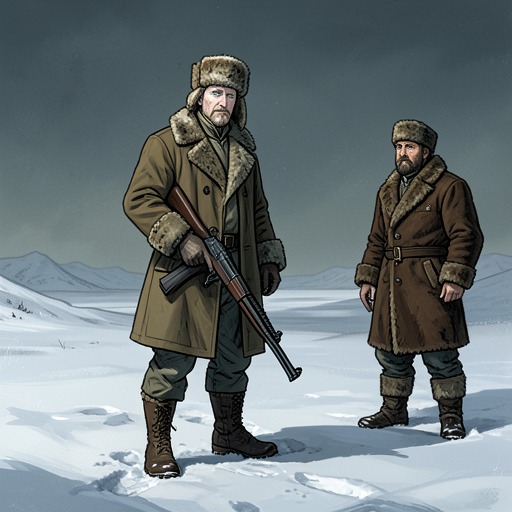
After the winter, Miller, William Andrews, Fred Schneider, and Charley Hoge prepared to leave the valley with a wagon loaded with hides. They left the remaining bales behind, treated them with the strychnine they had left to deter pests, and packed blankets and personal belongings on their horses. Hoge climbed onto the wagon’s high seat and cracked his whip over the oxen, whose hooves sank into the soft ground as they dragged the heavy load away. Its wheels carved deep parallel ruts through the grass, recording the weight of what the party had brought out of the valley.
At the pass, a palm’s depth of soft snow remained. The oxen crossed it, and Miller and Schneider checked the wagon’s brake before the descent. From the summit, Andrews looked back across the valley: spring grass shone in the morning light, but the dark carcasses of bison were still visible across the floor. The men then led their horses down beside the wagon, using ropes to steady its shifting load on the muddy, sloping trail. The crossing that followed came after this difficult descent, when the party and its cargo had already been committed to the journey home.
The Crossing and the Collision
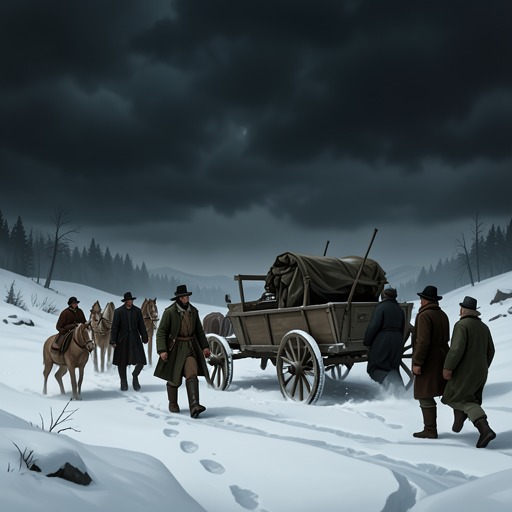
The river was in flood, but the party attempted a ford whose arrangement seemed to make the danger manageable. William Andrews crossed first and reached a shallow stretch without encountering holes or stones that might obstruct the wagon. From the far bank, he signaled the others. Miller answered with a raised arm, then rode into the river and directed Charley Hoge, mounted on one of the lead oxen, to bring the team forward. Fred Schneider followed upstream of the wagon, keeping several yards away as the hide load entered the current.
The crossing’s apparent safety depended on the oxen reaching the shallows in sequence: the lead animals would be in the deepest water while the oxen nearer the wagon could still help pull the load toward the bank. As the wagon advanced, Andrews understood the logic and felt his fear ease. Hoge dismounted near the shallows and slowed the oxen; Miller urged him to bring them on gently. Schneider, still upstream, rode beside the wagon at a measured pace, watching the water ahead.
Then Andrews saw a large broken tree trunk being carried downstream, half submerged and moving with the current. He ran along the bank and shouted a warning to Schneider, but the river’s roar obscured his voice. The trunk’s splintered end struck Schneider’s horse in the side. The animal struggled, gave a short cry, and fell toward the wagon, throwing Schneider into the water. As the horse rolled over, it crushed him; when it shifted again, a hind hoof struck his head. Schneider stiffened and sank beside the animal, his expression unchanged as blood spread across his face.
Loss and Aftermath
The impact that killed Fred Schneider also drove the wagon against the rocks. The hide bales swung under their own weight, the wagon overturned, and the current flooded its rear. Charley Hoge got clear of the oxen as the overturned load dragged them back into the river. For a moment the wagon drifted, steadied by the animals still caught in their yoke; then it scraped the rocky bed, turned, and pulled the oxen with it. When they lost their footing, the wagon accelerated downstream and battered against larger rocks. Its harness broke. The bison hides burst apart and vanished into the water, while the oxen and wreckage disappeared from the men’s sight. They continued looking downstream for several minutes, but the river gave nothing back.
The loss was both material and human. William Andrews fell to the ground in shock, calling out in anguish, but Miller stopped him from trying to search for Schneider. Miller judged that Schneider had already died in the water and that the current had carried away the oxen too quickly for a search to be possible. He described the winter’s work as gone in two minutes: the hides they had loaded, the wagon, and the team that had hauled them were all lost at once. The expedition had endured the mountain winter and brought its freight to the river, only for a chance collision in the flood to undo that labor almost instantly.
The loss did not mean that every hide the hunters had taken was in the river. They had left other bales in the valley, treating them with the remaining strychnine before departing. Later, Miller would point to three thousand winter hides still stored in the mountains and insist that they represented substantial value. But the expedition’s survival of the crossing disaster could not restore the commercial conditions on which that estimate depended. Miller had earlier arranged for J.D. McDonald to buy winter hides at four dollars apiece; on the return, McDonald’s account of the changed market exposed how little that bargain could now guarantee. The crossing thus separates the physical achievement of carrying hides out of the valley from the increasingly uncertain possibility of turning them into money.
That reversal belongs to a larger pattern of extraction and waste. Miller had recalled that Kansas’s plains, once black with bison, had been reduced to scattered herds, and Andrews had seen the valley’s remaining animals diminish amid the carcasses left by the hunt. Even the bones that once covered the hunting grounds could be taken for fertilizer, while railroad workers bought bison meat and hunters left the hides to rot where they had skinned the animals. Against this history, the river’s destruction of the wagon load is not a simple restoration of what the hunters had taken: the hides are lost without returning the slaughtered animals to life. The crossing makes the expedition’s dependence on transport and markets brutally visible, while its sudden violence echoes the much slower destruction that made the hunt possible.
The Commercial Chain Behind the Loss
The hides had value only through a chain that began with the hunt and continued through collection, processing, transport, and sale. J.D. McDonald had described buying bison skins from hunters, tanning them himself, and selling them wholesale in Saint Louis; he had processed nearly one hundred thousand the previous year and expected two or three times that volume next. Miller, however, had distinguished his own independent hunting from McDonald’s arrangement, under which hunters received fifty cents per head for thin summer hides. For the winter skins, Miller had secured a different promise: four dollars apiece, with McDonald claiming to have an eastern buyer. The river therefore destroyed freight whose prospective price rested on a specific bargain, not on value that could be realized automatically.
The bargain was already exposed to changes larger than the crossing. Miller had recalled that Kansas hunters once brought in a thousand to fifteen hundred bison in a two-week hunt, whereas now two or three hundred was a good return and the remaining herds were dwindling. Later, McDonald explained that the railroad would pass fifty miles north and that hunters were selling bison meat to the railway company for nearly five cents a pound while leaving the hides to rot in the sun. The lost wagon load and the three thousand hides still in the mountains thus belonged to a trade whose materials, routes, and buyers were changing at once. The flood made the danger sudden and visible; the shrinking herds and shifting market had been eroding the expedition’s prospects all along.